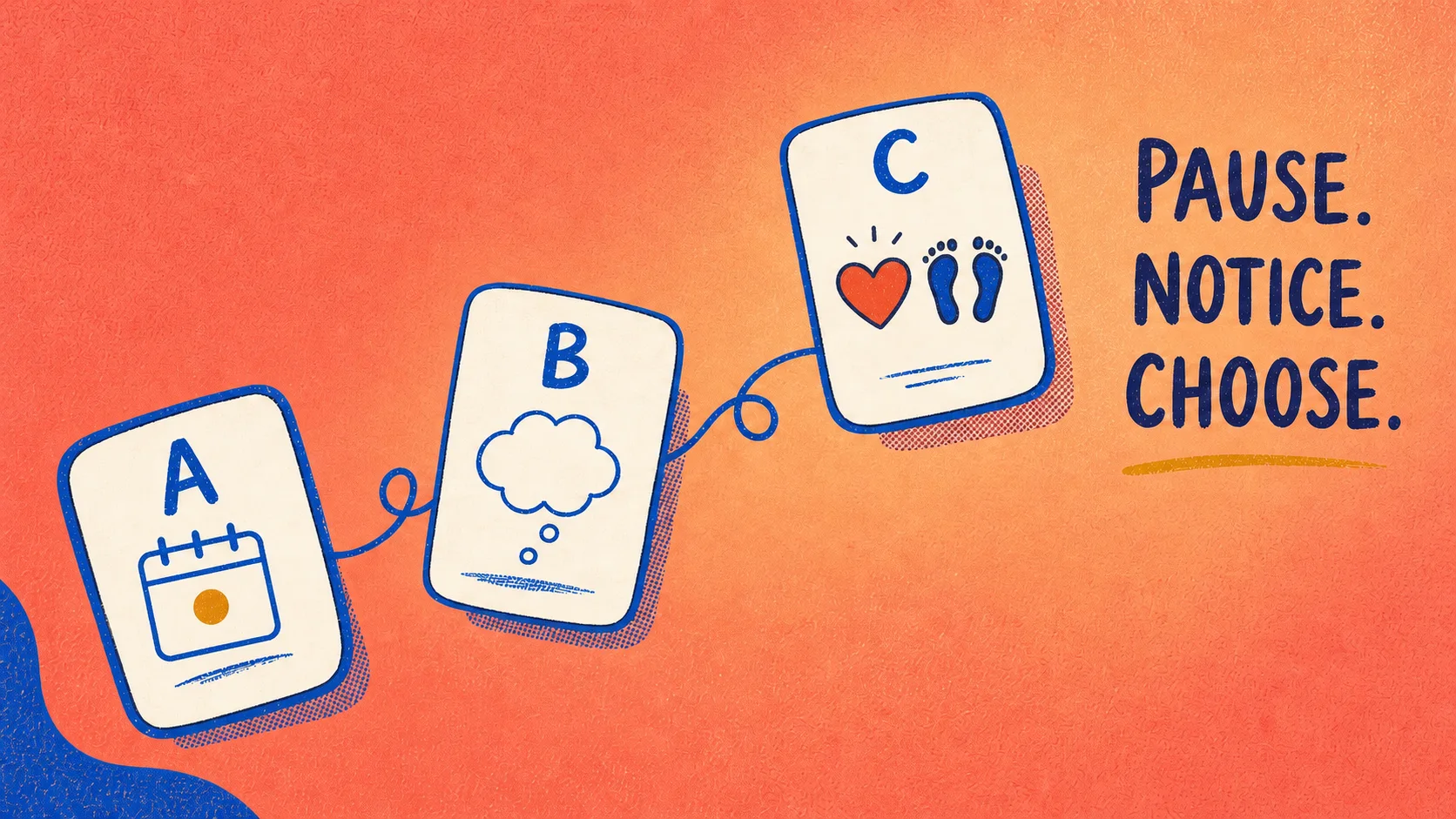
Two people can experience the same event and respond very differently. One unanswered message may produce mild curiosity in one person and intense worry in another. The event matters, but so does the meaning each person gives it.
The ABC Model separates that sequence into three parts: A, the activating event; B, your beliefs or interpretation; and C, the emotional and behavioral consequences. The model is most closely associated with psychologist Albert Ellis and Rational Emotive Behavior Therapy (REBT), an early cognitive-behavioral approach. It also reflects the broader CBT idea that how people perceive situations can influence how they feel and act.
A: Activating Event
The activating event is the situation that starts the sequence. It may be something that happened, something you remembered, a physical sensation, or a prediction about the future.
Describe A as a camera might record it. “My friend did not reply for six hours” stays close to observable facts. “My friend ignored me because I am annoying” already includes an interpretation and belongs under B.
B: Beliefs and Interpretations
B includes the thoughts, assumptions, rules, and meanings you connect to the event. Some thoughts arrive so quickly that they feel like facts: “I have done something wrong,” “This always happens,” or “If they are upset, I will not be able to handle it.”
Beliefs are not automatically false or bad. The aim is to notice them clearly enough to ask whether they are accurate, useful, overly rigid, or missing important context. A painful interpretation may be understandable and still deserve examination.
C: Emotional and Behavioral Consequences
C is what follows: emotions, physical reactions, and actions. The unanswered message might lead to anxiety, a tight chest, repeatedly checking the phone, sending several follow-up messages, or withdrawing from the friendship.
Consequences can feed the cycle. If you withdraw, you may receive less contact, which can appear to confirm the belief that the friendship is failing. Seeing the sequence makes that feedback loop easier to interrupt.
A Complete ABC Example
- A — Activating event: You make a mistake while presenting at work.
- B — Belief: “Everyone thinks I am incompetent. I must never make mistakes.”
- C — Consequence: Shame, physical tension, rushing through the rest of the presentation, and avoiding future speaking opportunities.
The model does not claim that the mistake had no effect. It shows that the belief adds a particular meaning to it. Another interpretation—“I made one visible mistake, and I can correct it”—might still produce disappointment, but it may support a calmer correction instead of avoidance.
How to Examine B
Write the first thought exactly as it appeared, then explore it with questions rather than forcing a cheerful replacement:
- What evidence supports this belief, and what evidence does not?
- Am I treating a possibility as a certainty?
- Am I using words such as always, never, must, or unbearable?
- Are there other explanations that also fit the facts?
- What would I say to someone I care about in this situation?
- What belief would be both realistic and more helpful?
A balanced belief does not deny difficulty. “I wish I had not made that mistake, but one mistake does not define my ability” is more credible than “Everything is perfect.” The goal is flexible accuracy, not automatic positivity.
From ABC to ABCDE
REBT often extends the framework. D stands for disputing or examining an unhelpful belief. E describes an effective new belief or effect. Some versions also add F for the new feeling that follows.
Using the presentation example, D might ask whether competent people truly never make mistakes. E might become: “I prefer to present smoothly, but I do not have to be perfect to be capable.” The resulting feeling may shift from overwhelming shame to manageable disappointment.
Use the Model Without Blaming Yourself
The ABC Model can be misused if it turns into “your feelings are only your fault.” Events, relationships, discrimination, loss, illness, and unsafe conditions have real effects. Sometimes distress is an appropriate signal that something needs protection, support, or change.
The framework offers a place to look for additional choice; it does not erase context or require you to debate every feeling. Validation and curiosity can exist together: “This reaction makes sense given what happened, and I want to understand the belief making it even heavier.”
A Simple ABC Note
Choose one recent, manageable situation and write:
- A: What happened, using observable details?
- B: What did I tell myself it meant?
- C: What did I feel in my emotions and body, and what did I do?
- Alternative: Is there a more balanced interpretation and one helpful next action?
You cannot always choose the activating event or your first reaction. You can learn to notice the meaning between them and decide what deserves another look.
This exercise is educational and is not a substitute for mental-health care. Difficult or traumatic experiences can be safer to explore with a qualified professional, and persistent or worsening symptoms deserve professional support.