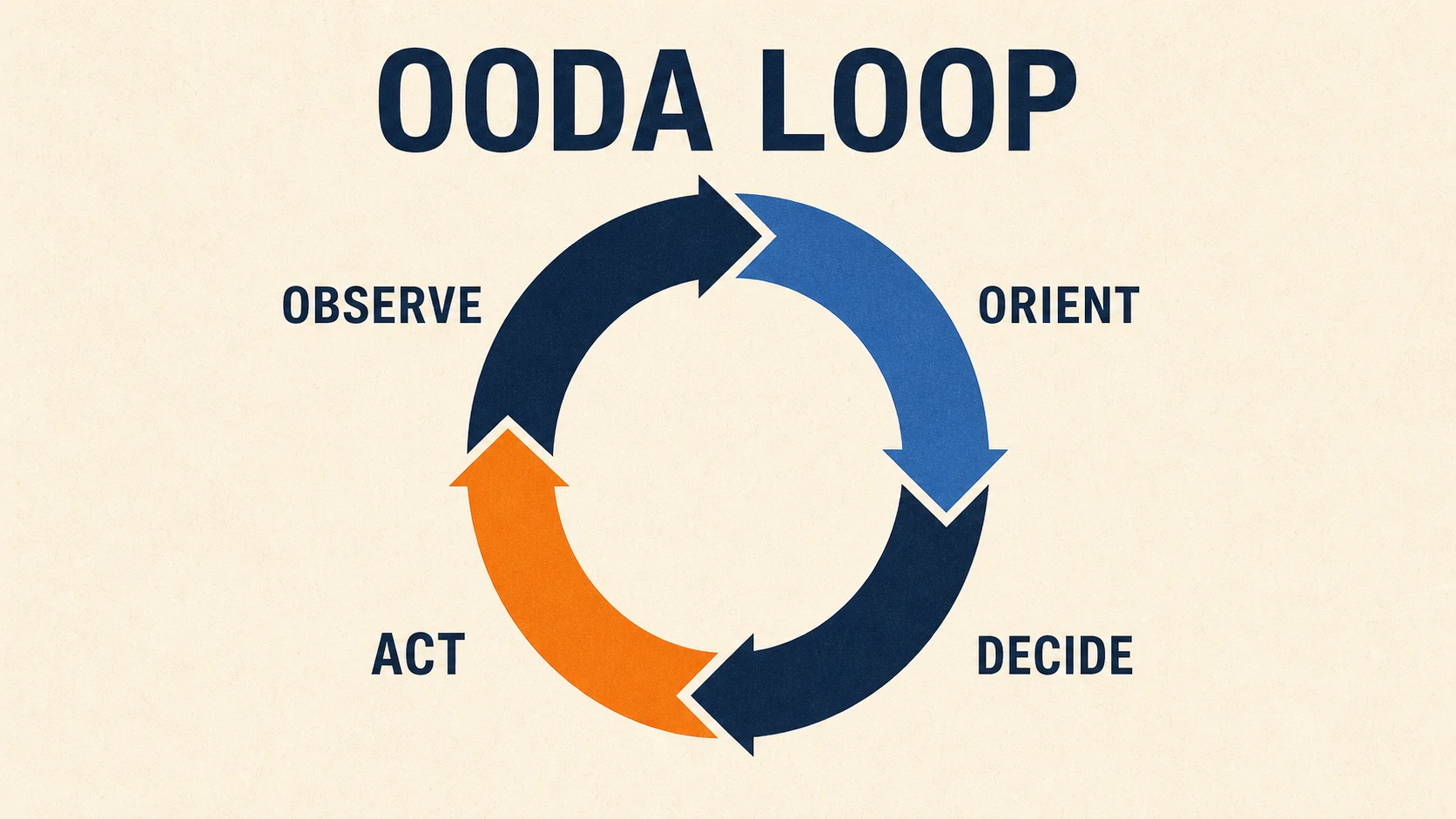
When a situation changes quickly, a detailed plan can become outdated before you finish it. The OODA Loop offers a different approach. Instead of treating a decision as a one-time event, it turns decision-making into a cycle: Observe, Orient, Decide, Act, then repeat with new information.
The framework was developed by U.S. Air Force strategist John Boyd to explain performance in conflict, but its basic idea applies anywhere feedback matters: debugging code, managing a project, responding to an incident, learning a skill, or testing a business idea.
Observe: See the Situation as It Is
Observation means collecting current signals before reaching for an answer. What changed? What results are you getting? What constraints are real? What are users, logs, numbers, or teammates telling you?
The common mistake is collecting only information that supports the first idea. Good observation separates evidence from assumption. “Visitors leave the page quickly” is an observation. “They dislike the design” is already an interpretation and may be wrong.
Orient: Make Sense of the Evidence
Orientation is the most important and most overlooked part of the loop. You connect the observations to your experience, goals, mental models, and context. You ask what the evidence could mean and which assumptions need updating.
Two people can observe the same event and orient differently. A slow website might look like a server problem to one developer and an oversized-image problem to another. Their models guide what they notice next. Better orientation comes from testing those models instead of defending them.
Decide: Choose a Testable Direction
A decision is a hypothesis about what should happen next. It does not need to solve the entire problem. It needs to be clear enough to act on and small enough that feedback arrives before the situation changes again.
For the slow website, the decision might be: “Compress the three largest images and measure the page again.” That is stronger than “improve performance” because it defines an action and a result you can inspect.
Act: Create New Information
Action is where the loop touches reality. Make the change, run the experiment, send the draft, or speak to the user. The outcome becomes the next round of observation.
People often remain stuck between orientation and decision because they want certainty first. The loop reminds you that carefully chosen action is one of the best ways to obtain missing information.
Speed Means Learning Speed
“Move faster” does not mean making reckless choices. The advantage comes from completing useful loops sooner than the problem changes. A small reversible test can teach more than a week spent building a perfect plan around an untested assumption.
Some decisions are expensive or irreversible and deserve a slower loop. Before acting, ask how easily you can undo the choice and how quickly you will see its effects. Move quickly when mistakes are cheap; slow down when safety, money, privacy, or trust is difficult to recover.
A Practical OODA Note
For everyday work, write four lines:
- Observe: What do I know, and what is only an assumption?
- Orient: What does this probably mean in the current context?
- Decide: What is the smallest useful next test?
- Act: What will I do, and when will I review the result?
Imagine a tutorial receives plenty of visits but few readers reach the final section. You observe the drop-off in analytics. You orient by reviewing the page on a phone and notice a long introduction before the first example. You decide to move a working example near the top. You act, publish, and compare the next week of data. The new result starts the next loop.
Where the Loop Fails
The framework breaks when you rush through orientation, mistake activity for action, or refuse to revise your view after receiving feedback. It also fails when there is no clear measure of what happened. Decide what signal you expect before you act.
The power of the OODA Loop is not making one fast decision. It is becoming faster at correcting the decisions that reality proves wrong.
Use the loop when the path is uncertain but feedback is available. Observe honestly, orient with humility, decide at the right scale, and act in a way that teaches you what to do next.