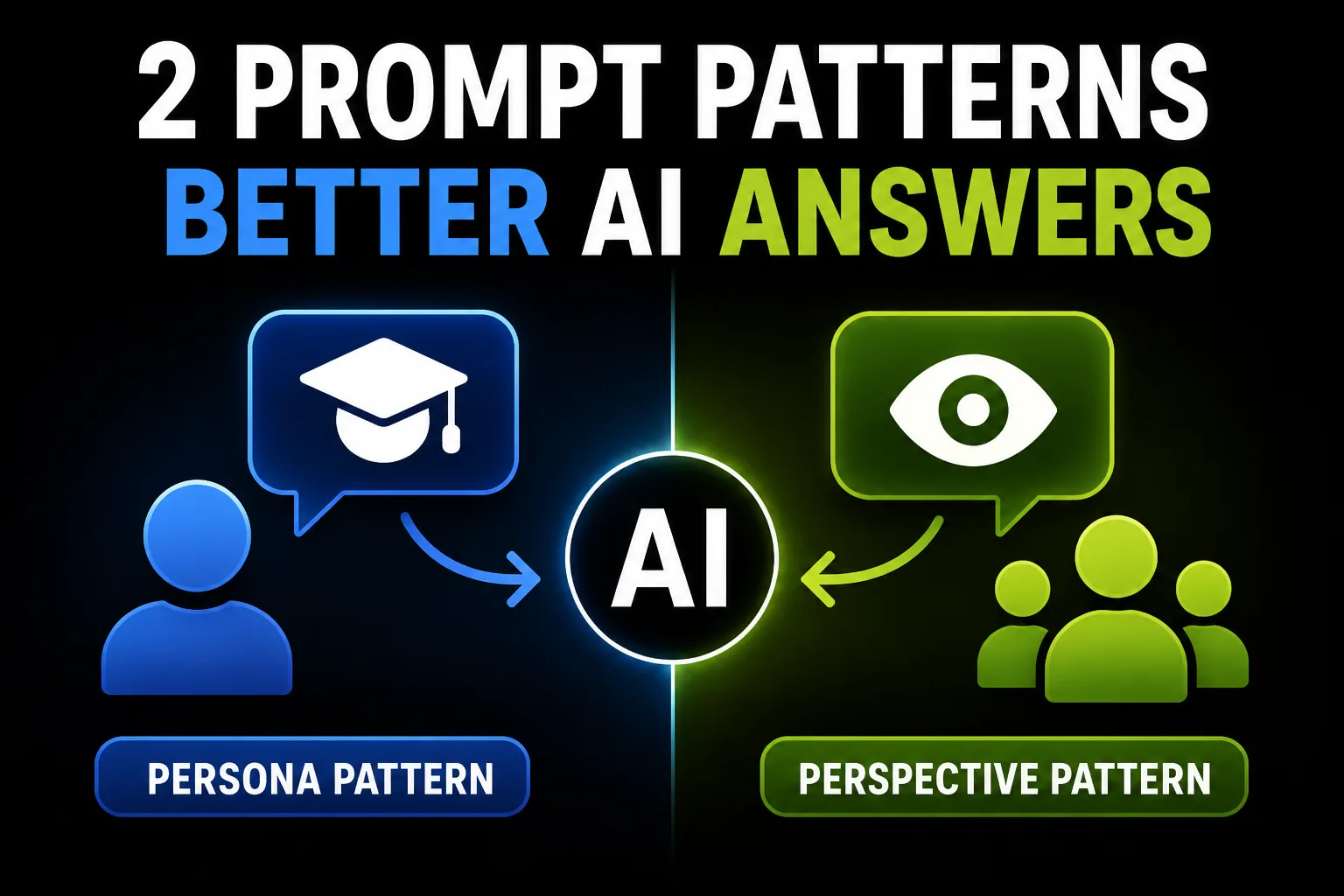
Most people write prompts as flat questions: "Explain phishing." "Explain cryptography." "Explain social media." You will get an answer, but it will usually be generic because you have not told the AI who it is speaking as, or who it is speaking to.
There are two simple patterns that fix this. I call them the Persona Pattern and the Perspective Pattern. Once you notice them, you will start using them everywhere.
Pattern 1: The Persona Pattern
The shape of this pattern is always the same:
Act as a [role], and explain [topic] to [audience].
You are not just asking for information. You are asking the AI to become someone with a specific expertise, and then explain something the way that person actually would.
Here are a few examples of how this changes the answer:
Cybersecurity expert, explaining phishing. Ask a cybersecurity professional to explain phishing, and they will not just define it. They will break down email phishing and SMS phishing, also called smishing, as different attack surfaces. They will also give you real defenses, not just textbook theory.
An artist with ten years of experience, explaining a tree. This example shows the pattern's real power. If you ask a general AI to describe a tree, you get a physical description. But if you tell it to act as an experienced artist, the answer changes shape. It stops being only "here is what a tree looks like" and becomes "here is how a tree grows, and that is why you paint it this way." The expertise is not only in the facts. It is in how the person thinks about the subject.
A doctor, explaining a treatment or health claim. An experienced doctor will not oversell something. Ask a doctor persona to explain a supplement, a diet trend, or a medical procedure, and you are more likely to get a grounded, non-hype answer instead of a marketing pitch.
Same topic, different audience. This is where the pattern gets really useful. Take cryptography:
- Explain cryptography to a 10-year-old. You get simple analogies, no math, and no jargon.
- Explain cryptography to a CEO. The answer skips the math and focuses on business risk and trust.
- You are a cybersecurity professor. Explain cryptography to a first-year cybersecurity student. The answer gives foundational vocabulary and enough technical depth to build on, without becoming overwhelming.
Same underlying facts. Three completely different answers. That is the point: the role you assign controls vocabulary, depth, and what gets emphasized.
Pattern 2: The Perspective Pattern
This one is a small but important shift. Instead of assigning a profession, you assign a viewpoint.
Explain [topic] from the perspective of [X], [Y], and [Z].
This works best for topics where different people genuinely experience the same thing differently, which is most topics if you think about it.
Take social media as an example. Ask for it to be explained from three perspectives:
- A parent's perspective: it is about connection, staying present in their kid's life, and that need feels more urgent than most people admit.
- A teenager's perspective: it is not just entertainment. It is where identity is actively being built, in public, in real time.
- A psychologist's perspective: the endless scroll is engineered around fear of missing out. The design is the story, not just the content.
These are three valid, non-contradictory answers to the same question because the lens changed, not the facts. If you asked the question flat, without perspectives, you would probably get one flattened, balanced answer that misses the nuance.
One Variant Worth Knowing
There is a related trick: Imagine you have no constraints. Now explain X. This can reduce the AI's instinct to hedge and produce a safer middle-ground answer, which can make the response sharper and more opinionated.
It is genuinely useful for brainstorming and creative work. But use it carefully. For anything factual, technical, medical, legal, or safety-related, removing constraints can also remove accuracy and nuance you actually need. It is good for creativity, but risky for correctness.
Why This Works
Both patterns do the same underlying thing: they give the model a frame to think inside of, instead of leaving it to guess what kind of answer you want. A role narrows vocabulary and depth. A perspective narrows what gets emphasized and what matters about the topic.
The next time you write a prompt and the answer feels flat or generic, do not only add more detail to the question. Add a role or a perspective. It is a small change that consistently produces sharper, more useful answers.